12 Types of Marriages Practiced Around the World
Marriage is one of the oldest social institutions in the world, yet it almost never looks the same from one culture to the next. Most people picture a single familiar version of it, but historians and anthropologists have recorded a wide range of marriage practices across different regions and eras. What counts as a normal union in one society can be rare or completely unknown in another.
These forms are shaped by culture, religion, law, and economics, and each one reflects how a community understands commitment, family, and responsibility. Some unions bring two people together by personal choice, others are arranged by families, and a few involve more than one spouse.
Looking at the main types of marriages side by side makes it easier to understand the values behind them and the ways couples in Pakistan and around the world build a life together.
Types of Marriages Around the World
Following is a list of different types of marriages that are widespread now and have been for the past century:
1. Arranged Marriage
In many cultures, families play a central role in choosing a life partner rather than leaving the decision entirely to the couple. This practice is common in South Asia, the Middle East, North Africa, Sub-Saharan Africa, and the Caucasus. Family involvement often provides strong social support, and research shows these marriages can have high satisfaction levels.
Key Features of Arranged Marriages
- Families consider social status, religion, and compatibility.
- Couples may have limited or gradual choices in the process.
- Strong emphasis on family involvement and long-term stability.
- Many arranged marriages grow into love-based relationships, blending traditions with modern values.
2. Cousin Marriages
Marriages between cousins, especially cross-cousins (children of opposite-sex siblings), are practiced in about 10% of cultures worldwide. It is common in the Middle East, South Asia, and North Africa. Families often choose these marriages to keep property within the family and strengthen kinship ties.
In countries like Pakistan and Saudi Arabia, Islamic law permits cousin marriages. While there are some genetic risks, these unions can lower bridal costs and ensure daughters marry into trusted families. Some cultures also distinguish between parallel cousins (father’s brother’s children) and cross-cousins, with specific rules for each.
Key Features of Cousin Marriages
- Strengthens family and kinship bonds.
- Keeps property and wealth within the extended family.
- Reduces bridal or marriage-related costs.
- Often preferred in Islamic and certain traditional societies.
- Cultural rules may differ for parallel and cross-cousin marriages.
3. Love Marriage
Unlike arranged marriages, love marriages rely on mutual affection and personal choice. In this type of marriage, couples choose their own partners and prioritize emotional compatibility. First, they develop feelings for each other, and then they decide to marry. As a result, love marriages often reflect modern social values and emphasize personal freedom.
Why Love Marriages Are Popular
- Couples freely select their spouse, promoting personal choice.
- Emotional connection and compatibility play a central role.
- They reflect changing social norms and the growing value of autonomy.
- Love marriages are increasingly common in urban areas and Western cultures.
However, in some traditional societies, families still prefer arranged marriages because they believe parents understand what is best for their children.
4. Civil or Court Marriages
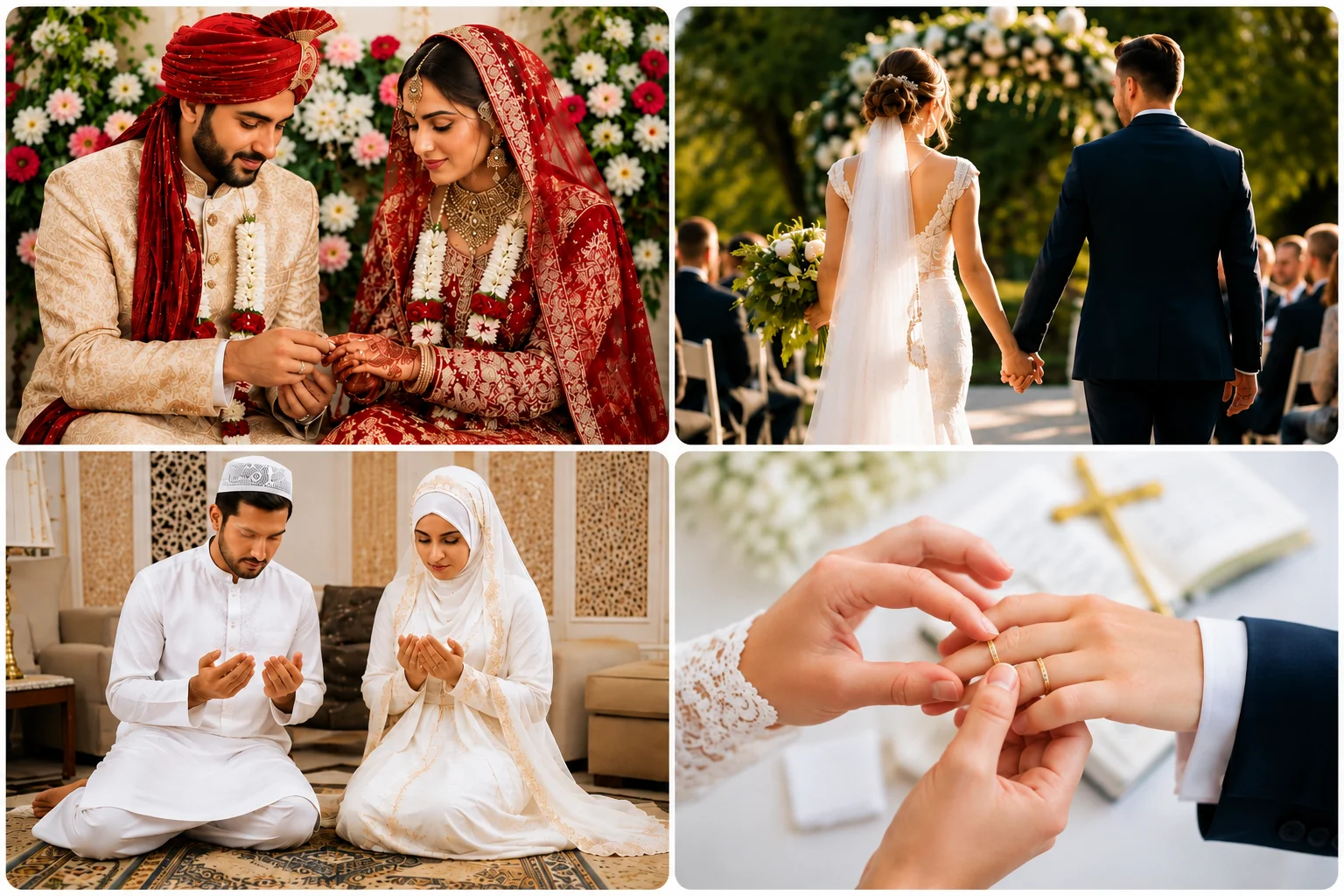
Generally, civil or court marriages are common in secular societies and countries with legal systems that separate religion from the state. They are especially popular in Western nations like the United States, Canada, and Europe, as well as in urban areas of countries such as India, Japan, and South Korea. Civil unions also appeal to interfaith couples and non-religious individuals who want a legally recognized marriage.
However, in Pakistan, court or civil marriages are not widely accepted and are often frowned upon because they bypass traditional religious rituals and family involvement, which many people see as essential for a legitimate marriage.
Common Features of Civil Marriages
- Governments legally recognize marriage, ensuring property and inheritance rights.
- Couples can be interfaith or non-religious.
- Civil ceremonies often take place in official venues such as municipal halls or registry offices.
- Registration provides immediate legal recognition for international documentation or legal purposes.
- They offer a simpler, flexible alternative to religious ceremonies.
5. Polygamous Marriage
Polygamous marriage occurs when a person has multiple spouses at the same time. There are two main forms:
Polygyny
In polygyny, a man has multiple wives. This is the most common type of plural marriage and is practiced in parts of Africa, the Middle East, and South Asia. Islamic tradition allows a man to marry up to four wives if he treats them equally, while in some African cultures, polygyny also serves as a status symbol. Many polygynous marriages exist for economic reasons, as co-wives often share childcare, household duties, and work responsibilities.
Polyandry
In polyandry, a woman has multiple husbands. This is much rarer and is mostly found in certain regions of Nepal and Tibet, usually due to economic or social reasons.
Features of Polygamous Marriages
- One person has multiple spouses at the same time.
- Often practiced for economic, social, or cultural reasons.
- Co-partners may share household duties and childcare.
- Legal recognition depends on the country’s cultural or religious norms.
- Customary rules often exist to manage relationships and prevent conflicts.
6. Monogamous Marriage
Monogamous marriage occurs when a person has only one spouse at a time. It is the most common type of marriage worldwide and is legally recognized in over 80% of countries. This form of marriage emphasizes mutual fidelity, emotional intimacy, and equal partnership.
Monogamy is especially common in Western countries and industrialized societies, where nuclear families are more practical than multiple-spouse households. Although most people aim to remain faithful, maintaining monogamy can sometimes be challenging.
Key Features of Monogamous Marriages
- Couples commit exclusively to one partner emotionally and legally.
- Most widely practiced in Western countries and globally recognized.
- Often supported by both legal systems and religious traditions.
- Emphasizes emotional intimacy, stability, and social recognition.
- Typically suits modern nuclear family structures.
7. Paper Marriage
A paper marriage is a fake or sham union in which people marry for legal or financial benefits rather than love or commitment. Often, one person uses marriage to gain immigration status, residency, or citizenship, while the couple has no real relationship.
Unlike authentic marriages, paper marriages are transactional and temporary, and as a result, they are both illegal and unethical.
Furthermore, governments worldwide treat paper marriages as serious crimes. For example, U.S. immigration authorities carefully investigate marriages suspected of fraud, requiring documentation and interviews to verify legitimacy.
In addition, religious scholars, including Islamic authorities, condemn paper marriages as haram, since they deceive the state and violate the principles of a valid marriage.
Key Features of Paper Marriages
- Marriage is entered for legal, financial, or immigration benefits, not love.
- Often involves no real emotional or lifelong commitment.
- Considered illegal and fraudulent in most countries.
- Religious authorities, such as in Islam, forbid these unions.
- Couples may face legal penalties if caught.
- Usually temporary and transactional, with predetermined or hidden motives.
8. Common-Law Marriage
Common-law marriage occurs when a couple lives together and presents themselves as married without a formal ceremony or registration. In some countries and states, such as; Canada, the UK, and certain U.S. states, these unions are legally recognized and provide many of the same rights as formal marriages.
Couples often choose common-law marriage for convenience or practicality. Legal recognition depends on behavior and cohabitation, rather than a wedding or license.
Key Features of Common-Law Marriages
- Both partners must intend to be married now.
- The couple lives together as spouses; no specific time is required.
- Both must be adults, of sound mind, and not married to anyone else.
- Provides rights similar to formal marriage in jurisdictions that accept it.
9. Interracial Marriage
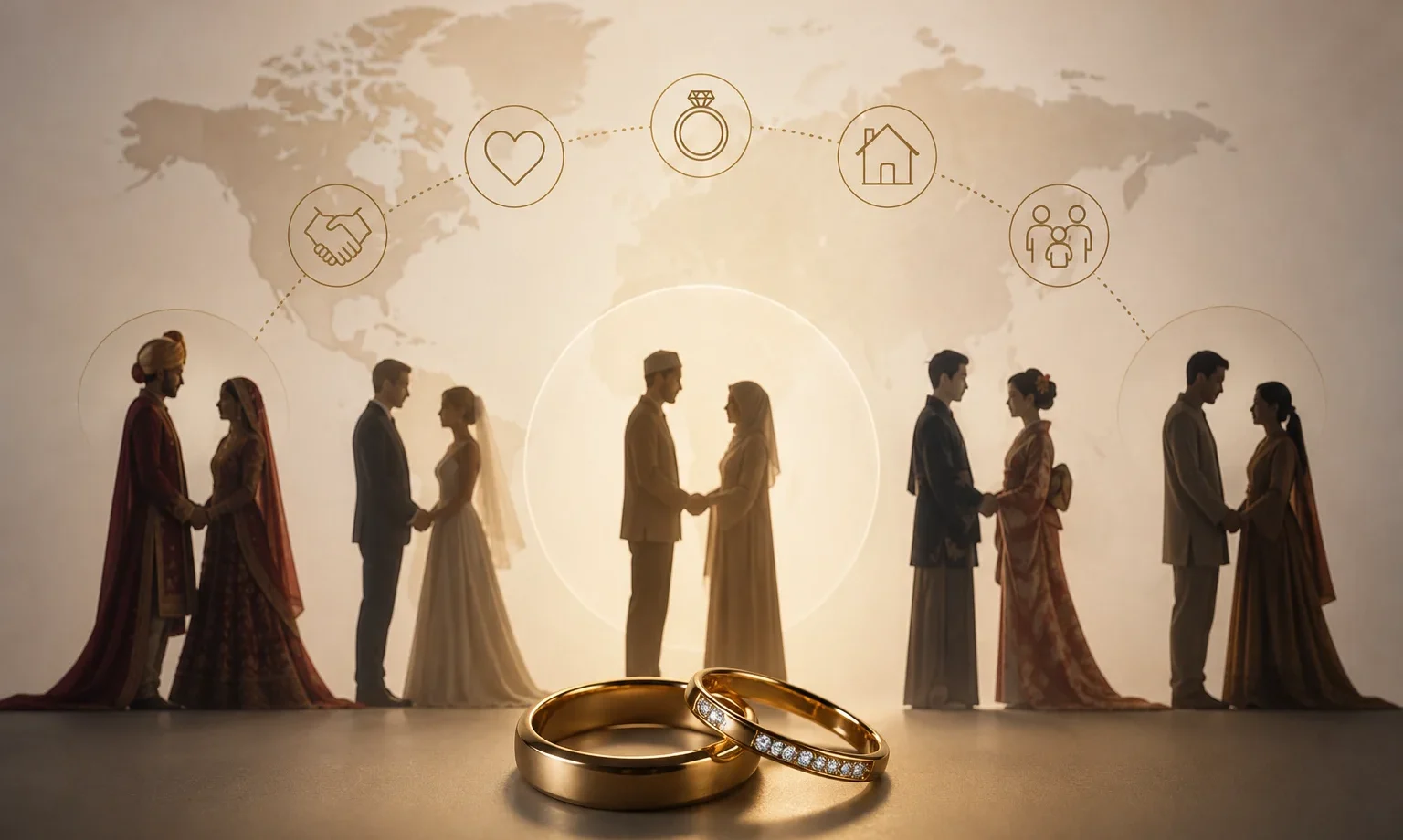
Interracial marriage occurs when two people from different racial or ethnic backgrounds marry. These unions promote diversity and cultural exchange, though couples may face social or family challenges in some communities.
Key Features of Interracial Marriages
- Partners belong to different races or ethnicities.
- Help bridge cultural gaps and promote understanding.
- Couples may face prejudice or social challenges.
- Legal in most countries worldwide.
- Often involves blending cultural traditions in family life.
10. Interfaith or Inter-religion Marriage
Interfaith marriage occurs when partners follow different religions. These unions promote tolerance and understanding, but they can also bring challenges related to rituals, family expectations, and religious practices.
In Islam, such marriages are permissible for a Muslim man to marry a Christian or Jewish woman, while generally, a Muslim woman cannot marry a non-Muslim man.
Key Features of Interfaith Marriages
- Partners practice different religions.
- Couples often blend religious practices and celebrations.
- May face family or societal resistance in some communities.
- Legal in most countries, though religious rules may vary.
- Encourage mutual respect and understanding of different beliefs.
11. Same-Sex Marriage
Same-sex marriage is a union between two people of the same gender. As of 2026, it is legal in around 38 countries, mainly in the Americas, Europe, and parts of Oceania. Taiwan and Thailand are the only Asian countries where it is legal, and South Africa is the only African country with full legalization.
Legal recognition is granted through laws, court rulings, or referendums, promoting equality and acceptance for LGBTQ+ communities.
Key Features of Same-Sex Marriages
- Receive the same rights as opposite-sex couples, including property, inheritance, and taxes.
- Have the ability to adopt children in most countries where it is allowed.
- Qualify for spousal visas and residency for immigration purposes.
- Hold civil or religious ceremonies; some religions perform weddings.
12. Temporary Marriage
It is a union that lasts for a set period and ends automatically without a formal divorce. In Shia Muslims, it is called Nikah Mut‘ah and is legally or religiously recognized in certain communities. It is mainly practiced in Iran and among Shia communities in Iraq, Lebanon, and Pakistan, while Sunni Muslims do not allow this type of marriage.
Couples agree in advance on the duration and terms and enter these marriages for practical, social, or religious reasons, making it a temporary but structured way to formalize a relationship.
Key Features of Temporary Marriage
- The marriage lasts for a predetermined period and ends automatically.
- Includes mahr and provisions similar to permanent marriage.
- Usually includes financial support or a dower for the woman.
- Historically served travelers, soldiers, and those avoiding permanent commitment while fulfilling religious requirements.
- Valid only in specific jurisdictions (e.g., Iran, parts of Iraq) and lacks universal acceptance.
Types of Marriage in Islam
In Islam, the standard and permanent form of marriage is Nikah, a formal contract between a man and a woman that sets out mutual rights and responsibilities. A valid Nikah requires the willing consent of both parties, the presence of witnesses, and an agreed mahr or dower given to the bride.
Beyond the permanent Nikah, a few other forms are sometimes discussed within Muslim communities. Polygyny allows a man to marry up to four wives on the condition that he treats them fairly. Mutah, a fixed-period marriage, is recognized mainly among Shia Muslims and is not accepted by Sunni scholars.
Misyar is another arrangement in which the couple gives up some customary rights, and scholars remain divided over it. In everyday practice, the permanent Nikah is the form that the large majority of Muslim families follow.
Endogamy and Exogamy
Sociologists also group marriages by the social rules that decide who a person may marry. Endogamy is the practice of marrying within a defined group, such as the same caste, biradari, religion, or community. It is common across South Asia, where many families prefer a match from a similar background to protect shared values and traditions.
Exogamy is the opposite idea. It means marrying outside a particular group, for example beyond the clan or the immediate family line. Many societies apply both rules at the same time, encouraging marriage within a broad community while forbidding it between close blood relations. These patterns explain why a customary marriage in one region can follow very different expectations than in another.
Modern and Non-Traditional Types of Marriage
As lifestyles change, some couples choose arrangements that do not fit neatly into the older categories. In an open marriage, both partners agree that one or both may keep relationships outside the marriage, though this remains uncommon and is rejected by most religious traditions. Another pattern that is slowly growing is living apart together, where a committed married couple keeps separate homes for work, study, or family reasons.
These modern forms are more visible in urban and Western settings and stay rare in more conservative societies. For most families in Pakistan, a registered religious marriage is still the trusted choice, whether it is arranged, semi-arranged, or based on personal liking.
Conclusion
Marriage takes many shapes around the world, from arranged and love matches to civil, religious, and temporary unions. Learning about these types of marriages helps you understand different cultures and the changing ways people define commitment.
In the end, the label matters far less than the effort behind it. A strong marriage rests on trust, respect, and compatibility, no matter which path a couple takes to reach it. Choosing the right partner, with clear values and shared goals, is still the most important decision of all.
Frequently Asked Questions
What is the most common type of marriage globally?
Monogamous marriage, one person with one spouse, is the most common worldwide.
Are arranged marriages more successful than love marriages?
Arranged marriages often report high satisfaction because of family support and realistic expectations, but success depends on commitment, compatibility, and mutual respect. Ultimately, the success of any marriage depends on commitment, compatibility, and mutual respect, rather than how the marriage began.
Is cousin marriage dangerous?
First-cousin marriage slightly increases genetic risks for children (about 2–3%), and repeated cousin marriages over generations can increase risks further.
What’s the difference between civil and religious marriage?
Civil marriage is a legal contract recognized by the state, while religious marriage is a sacred covenant under religious law. Many couples have both.
Are same-sex marriages recognized everywhere?
No, legal recognition varies by country. Some countries fully allow same-sex marriage, while others prohibit it.
Is child marriage legal?
In most countries, child marriage is illegal, but it still happens in some regions due to cultural, social, or economic reasons.
What are the risks of child marriage?
Child marriage increases the risk of health problems, early pregnancy, limited education, and domestic violence.
What are the three major types of marriage?
The three major types are monogamy, polygamy, and temporary or contractual marriages.
How does psychology define different types of marriages?
Psychology views marriages based on emotional bonds, decision-making styles, power balance, and social influence, rather than just cultural labels.
Are love marriages psychologically stronger?
Love marriages often start with strong emotional attachment, but they require ongoing effort to manage expectations and conflict over time.
What are the types of marriage in Islam?
The main form is a permanent Nikah, a marriage contract that needs the consent of both parties, witnesses, and a mahr for the bride. Islam also permits polygyny of up to four wives under strict conditions of fair treatment. Mutah, a fixed period marriage, is recognized mainly by Shia Muslims, while most Sunni scholars do not accept it.
Which type of marriage is the best?
There is no single best type for everyone. The right choice depends on your faith, family, and personal values. What matters most is mutual respect, honesty, and compatibility, because these decide the strength of a marriage far more than the label attached to it.